Abner Fuller Proof Summary
Companion Website
|
| Proposed ancestor line: Edward1 (Mayflower) - Samuel2 - John3 (Little John) - Samuel4 - Abner5 - Abner Jr6 - George7 - George8 - Ambert9 - Joseph10 - Joel11 - Kevin12 |
|
Project Summary As a genealogist and direct patrilineal descendant of Edward Fuller of the Mayflower—confirmed through Big Y DNA—my primary focus is to document and prove the life and lineage of Abner Fuller, born in 1724 in Colchester, Connecticut. In the Mayflower numbering system, he is Abner⁵, and I, Kevin Fuller¹², am seven generations removed from him through an unbroken line of Fuller males. For decades, several widely referenced genealogical sources—including published compilations and the Mayflower Society’s Silver Books—have stated that Abner⁵ “probably died young.” However, my research demonstrates that this assumption is incorrect. A growing body of evidence shows that Abner⁵ lived a long and active life, ultimately reaching nearly one hundred years of age before his death in 1824 in Easton, New York. Land records, court documents, military service in both the French & Indian War and the Revolutionary War, probate files, census data, and family wills all contribute to a clear picture: Abner⁵ did not disappear early in life. Instead, he migrated north, established a farm in Schaghticoke/Easton, raised a family, and left a well-documented legacy. Correcting this long-standing misconception restores Abner⁵ to his rightful place in the historical record and reestablishes a lost branch of the Fuller Mayflower lineage—one that continues through Abner⁶, George W.⁷, and ultimately down to me as the twelfth generation from Edward¹. My niece and I began this research in 2020. In January 2023, we created a website—edwardfullerfamilytree.org—to collect and share our findings. (Much of that material has since been incorporated into WikiTree profiles.) This new website, however, is dedicated entirely to Abner⁵ Fuller. It will present both previously known and newly discovered documents in a less formal, more exploratory format. Here, I will include analysis, informed assumptions, personal observations, and even research anecdotes as they relate to reconstructing Abner⁵’s remarkable life. |
|
Research Objective
To prove that Abner Fuller5, born in 1724 in Colchester,
Connecticut, is the same individual who later settled in
Schaghticoke, Albany County (now Washington County), New York,
and died in Easton in 1824 at the age of 99 years and 7 months.
This objective includes:
|
 |
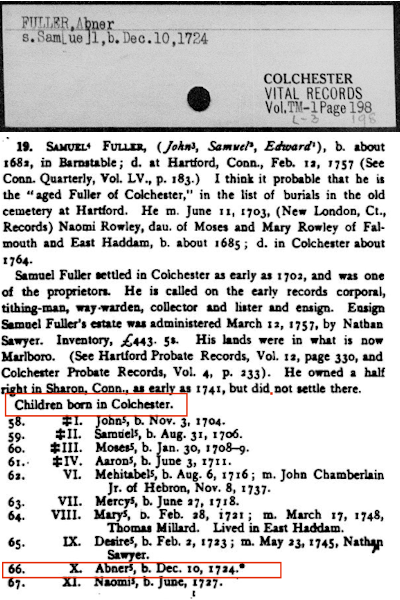 |
Was Abner born? Yes, he was. Abner Fuller was born on December 10, 1724, in Colchester, Connecticut, the son of Samuel Fuller and Naomi Rowley. His birth appears in the Colchester town records, preserved today in the Barbour Collection of Connecticut Vital Records. This entry provides the earliest documentary evidence of his existence and firmly places him within the Fuller family of Colchester. The Fuller lineage is deeply rooted in New England history, tracing back to Edward Fuller of the Mayflower, and Abner’s inclusion in both 19th- and 20th-century genealogies reinforces this longstanding connection. Abner is listed on page 42 of William Hyslop Fuller’s Genealogy of Some Descendants of Edward Fuller of the Mayflower, an early and respected lineage compilation. He also appears in the General Society of Mayflower Descendants’ Silver Book series—specifically on page 44 of Volume Four (2nd edition). Although the Silver Book speculates that Abner “probably died young,” the historical record proves otherwise. Abner lived a long and active life that took him from Connecticut to Schaghticoke and Easton, New York, where he eventually died at nearly 100 years old. This website seeks to correct that long-standing misconception by presenting the comprehensive evidence of his full and well-documented life. But did he die young? No, he did not.In the sections ahead, we will explore documents recently uncovered at the Connecticut State Library, including Hartford County Court records that remained unexamined and undigitized for more than 270 years. These rarely opened case files reveal a surprising amount about everyday colonial life—business loans, debtor’s prison, property disputes, even irregular marriages. Through these records, we now know that Abner participated in legal and economic activities well into adulthood, offering further proof that he did not die young, but instead lived a long and eventful life across two colonies. |
| January 12, 2026 Update: I am continuing to add each section as time permits. |
|
The given name Abner was unusually popular in the 18th century, and the Fuller family was no exception. In this lineage, the first was Abner⁵ Fuller, born 10 December 1724, the tenth child of Samuel Fuller and Naomi Rowley. Naomi bore children over a span of twenty years, beginning with her eldest son John, born in 1704. When John married Sarah Clothier in 1727, he continued the family naming tradition—calling his own son Abner⁶ in 1737. These two men, uncle and nephew, would confuse genealogists for nearly three centuries, a problem compounded by the fact that both later named sons “Abner” as well. Prior to the births of their own children—around the 1770s—Abner⁵ and Abner⁶ were the only individuals in the extended Fuller family bearing the name. Over time, the Revolutionary-era military service of these two men has been repeatedly conflated by researchers. However, a careful review of surviving records reveals that they lived separate and clearly distinguishable lives. Abner⁵, the elder, appears in business dealings and legal proceedings at dates when his nephew was still legally a minor. He served in the French & Indian War from 1755 to about 1760 under Colonel Nathan Whiting of the Connecticut Regiment. Later, after establishing a farm in Schaghticoke, New York, he served in an Albany County militia during the American Revolution. This Abner—Abner⁵ of Schaghticoke and later Easton—married Ruth Weaver and lived a long life, dying in 1824 at nearly one hundred years of age. The nephew, Abner⁶, lived an entirely different life and remained in Connecticut until his death in 1776. He married Mary Hilliard (Hillyard) Crowfoot in July 1767, and they had two sons, Daniel and Abner⁷. During the Revolution, he served in Captain Ebenezer Fitch Bissell’s company (Conn. Hist. Soc. Coll., 8:27), was captured by British forces, and tragically died aboard a British prison ship in New York Harbor—likely at the same time Mary was giving birth to their youngest son. After exhaustive examination of colonial and Revolutionary-era Connecticut records, it is clear that only two men named “Abner Fuller” were living in this region during this period: Abner⁵ (b. 1724) and Abner⁶ (b. 1737). Therefore, because the nephew, Abner⁶, lived and died (at 39 years of age) exclusively in Connecticut, he can be excluded from the body of evidence pertaining to Abner⁵, the man who served in New York and settled in Schaghticoke/Easton.
|
|
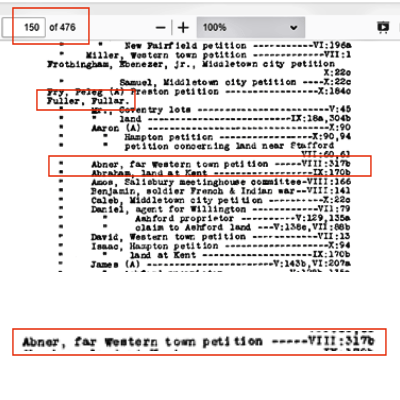
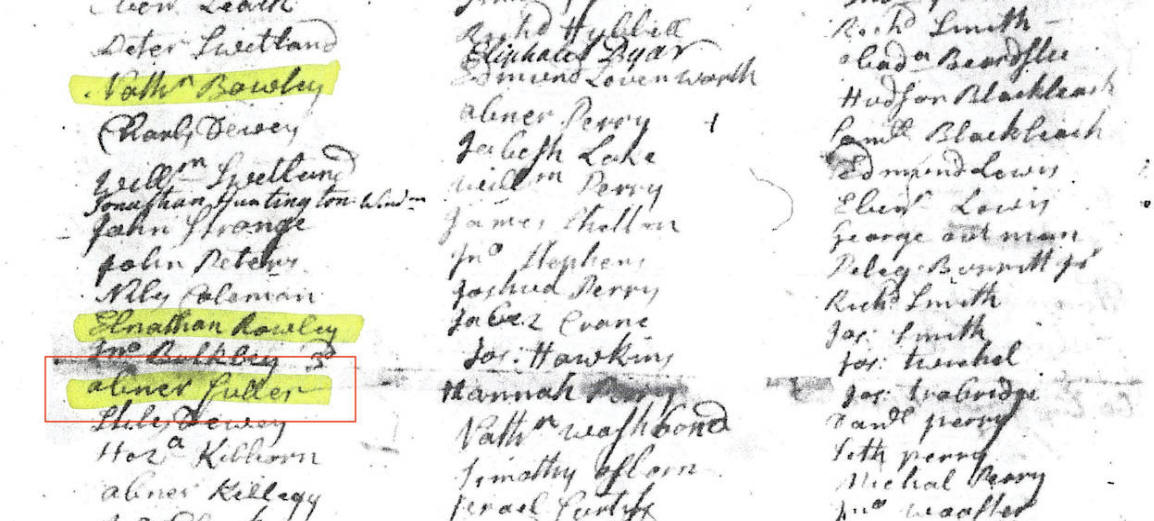
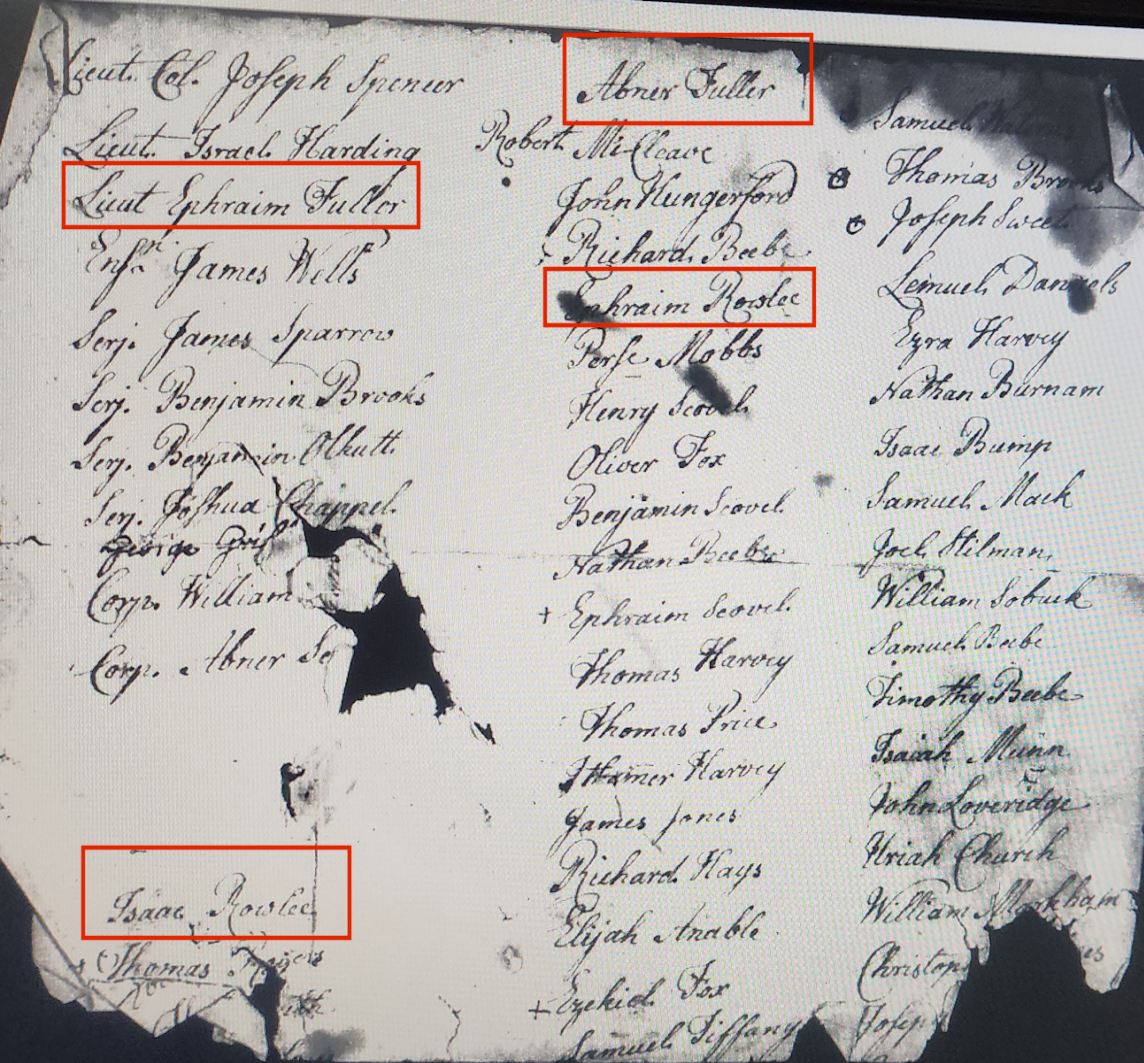
1752 Hartford Petition The earliest known record of Abner Fuller as an adult appears in a 1752 petition submitted to the General Assembly of the Colony of Connecticut at Hartford. Abner was 28 years old at the time. The original petition is preserved at the Connecticut State Library. An index entry in Connecticut Archives: Towns and Lands, 1629–1789 identifies Abner as one of the petitioners seeking rights to lands in what the index describes as a “far western town.” The petition itself states that the petitioners were requesting “a considerable tract of land lying to ye westward of Hudson's River.” The document spans two and a half pages and is signed by numerous men, including Abner, his Fuller relatives and some Rowley (Rowlee) cousins. This early reference is particularly meaningful because, many years later, Abner settled on farmland just east of the Hudson River in what became Schaghticoke and later Easton, New York. There he worked as a tenant farmer on land owned by General Philip Schuyler, part of the extensive Saratoga Patent. The petition may represent the earliest indication of Abner’s interest in western lands—a path he would eventually follow. Below are images of the petition, a full transcription, and a snippet of the second signature page showing Abner’s name.
|
 |
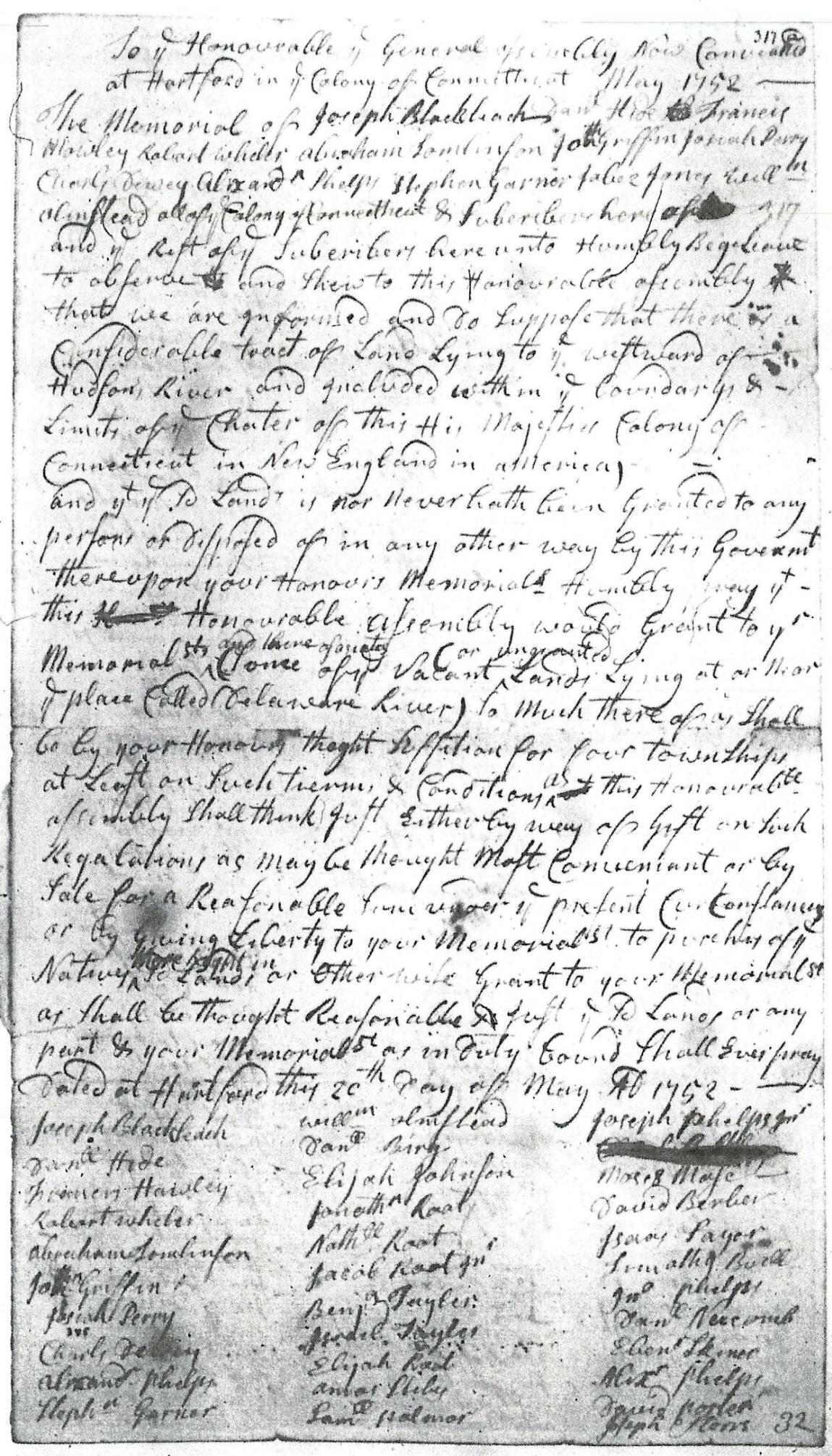 Transcription of 20 May 1752 Hartford Petition:
To ye honorable
ye general assembly now convened at Hartford in ye colony of
Connecticut May 1752—
The memorial of
Joseph Black___,
Daniel Hide, Francis ?Rowley, Robert Wheler, Abraham Tomlinson.
John Griffin, Josiah Perry, Charles Dewey, Alexander Phelps,
Stephen Garner, Jabez Jones, William Olmstead, all of Colony of
Connecticut & subscribers hereof and ye rest of ye subscribers
hereunto humbly beg leave to ?absence? and show to this
honorable assembly that we are ?informed? and do suppose that
there is a considerable tract of land lying to ye westward of
Hudson River and included within ye boundarys & limits of ye
charter of this His Majesties Colony of Connecticut in New
England in America – and ?yt ye to Land is nor never hath been
granted to any persons or disposed of in any other way by this
government thereupon your Honours Memorials humbly pray ?yt this
honorable assembly would grant to ye memorials to and their
associates some of ye vacant or ungranted lands lying at or near
ye place called Delaware River so much thereof as shall be by
your honors thought sufficient for four townships at least on
such tierms (terms) & conditions as this honorable assembly shall think
just either by way of gift on such regulations as may be thought
most convenient or by sale for a reasonable sum ??? ye present
???? or by giving liberty to your memorials to purchase of ye
natives in ye lands, or otherwise grant to your memorials as
shall be thought reasonable & just if ye lands or any part &
your memorials as in duty bound shall ever pray.
Dated at
Hartford this 20th day of May AD 1752 - -
and here is the signatory page with Abner
Fuller and some Rowley cousins:
|
 |
1753 Loan from John Bannister, Merchant of Newport Rhode
Island
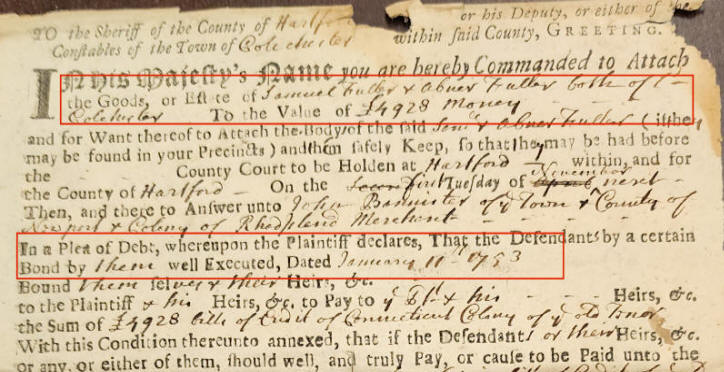
Among the Hartford County Court records is a case involving a significant debt incurred on January 11, 1753, in which Samuel Fuller and his son Abner Fuller are named as co-defendants. The loan was extended by John Bannister, a prominent merchant of Newport, Rhode Island, whose extensive commercial network often reached into Connecticut. The appearance of both Samuel and Abner together in this legal action provides valuable confirmation of their joint financial activities during this period and helps establish a clearer picture of the Fuller family's economic circumstances in the early 1750s. |
|
1754 Bannister
Loan Default Lawsuits
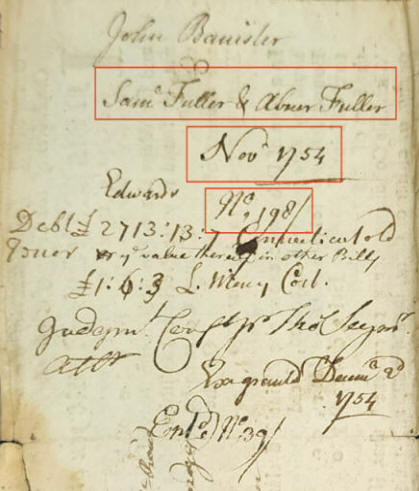
The Hartford County Court Docket lists two suits filed against Samuel Fuller and Abner Fuller for defaulting on the repayment terms of a significant loan. They are case #198 and #199 on the docket index.
I believe the defendants in this case were father and son, based on several pieces of supporting evidence discussed below. Contemporary accounts refer to an “Aged Fuller of Colchester” who died in the Hartford Prison in February 1757. Probate records for Samuel Fuller confirm that Nathan Sawyer, husband of Samuel’s daughter Desire Fuller, was appointed administrator of the estate. This places the elder Samuel squarely within the family structure documented in Colchester. At the time of these events, three men named Samuel Fuller were associated with the Colchester area: Samuel⁴, age 75; his son Samuel⁵, age 51; and his grandson Samuel⁶, age 27. Both Samuel⁵ and Samuel⁶ died in May 1757, only a few months after the elder Samuel’s death in the Hartford Prison. These clustered deaths strongly indicate that the “Aged Fuller” referenced in the historical record was Samuel⁴, the patriarch of the family. Meanwhile, Abner Fuller—Samuel⁴’s son—entered military service in Connecticut’s 2nd Regiment in 1755. Taken together, the available evidence suggests a family under financial and legal strain: Samuel⁴ likely faced imprisonment due to the substantial debt owed to Newport merchant John Bannister, while Abner responded to the pressures of the period by entering military service. These aligned events provide crucial context for understanding the Fuller family’s circumstances in the mid-1750s and offer further documentary support for Abner’s continued presence and activity during these years. |
 |

 |
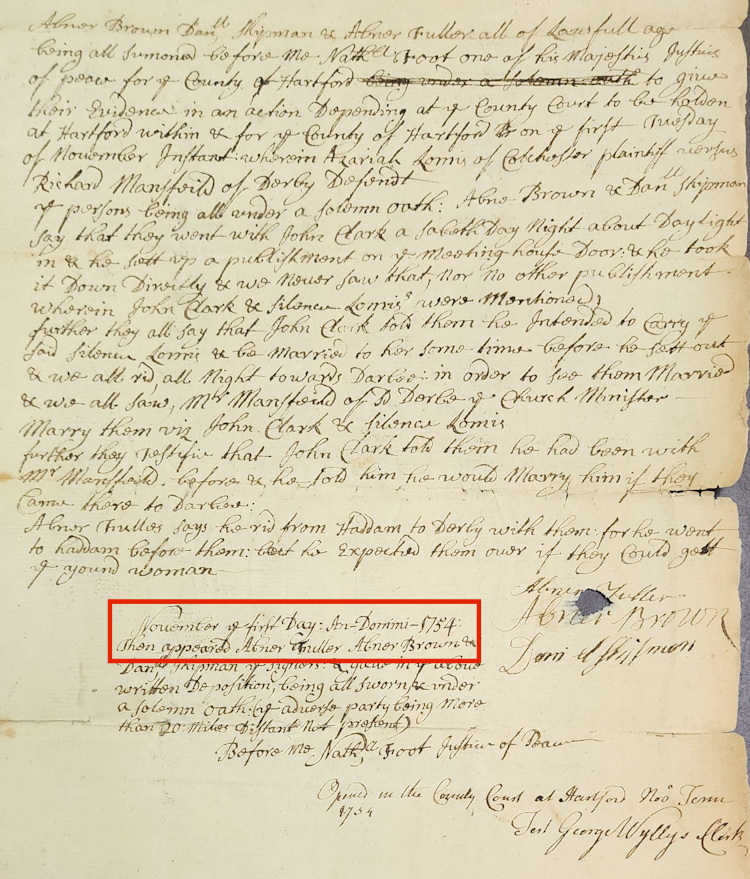 |
Abner's Spirit is Helping Me!An Unexpected DiscoveryWhile reviewing a set of colonial court files stored in a single archival drawer, an unexpected sheet of paper slipped loose and fell onto the desk. To my surprise, the name “Abner Fuller” appeared prominently on the page. It felt almost as though Abner himself were guiding the research, revealing a document that had gone unnoticed among hundreds of case packets. The file in question concerned Loomis v. Mansfield of Darbee, Connecticut (November 1754), a civil action involving an unauthorized marriage performed by a local minister. Within this case packet were both a summons and an affidavit, each bearing the name Abner Fuller, thereby confirming his presence in the community and involvement in legal matters during this period. The case centered on Reverend Mansfield, who had married Silence Loomis, then seventeen years old, to John Clark without the knowledge or consent of her father. Mansfield ultimately lost the suit and was assessed a fine for his actions. The circumstances of the marriage require little imagination to interpret; the secrecy surrounding the ceremony suggests a compelling personal motive on the part of the young couple. For genealogical purposes, however, the greater significance lies in the unexpected documentation of Abner Fuller’s participation in local legal affairs, adding yet another piece to the growing body of evidence demonstrating that he lived a full and active life well beyond what earlier genealogical sources had assumed. |
|
1755 Col. Nathan Whiting
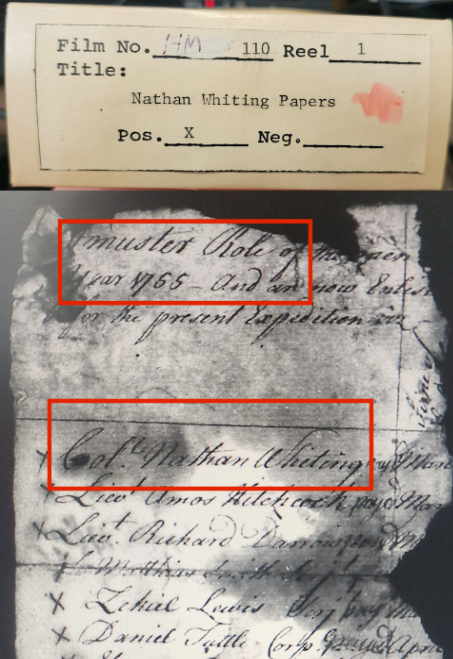
Papers at Yale University In May 2025, I visited Yale University to inspect the records of Nathan Whiting. I was hoping to find a copy of the 1760 Sargeant's Commission issued to Abner Fuller. Instead, I found the 1755 Muster "Role" of Connecticut men in the 2nd Regiment of Col. Nathan Whiting... One of the most significant breakthroughs in reconstructing the life of Abner Fuller (b. 1724) came with the discovery of his name on the 1755 Muster Roll of Colonel Nathan Whiting’s Regiment during the French & Indian War. The colonial records show Abner serving among Connecticut troops raised for the Crown’s campaigns along the northern frontier. His name appears alongside dozens of other men from the Colchester region, firmly placing him in military service at a pivotal moment in New England history. This roll not only confirms his presence in Connecticut as a young adult but also demonstrates that he was actively engaged in the conflicts and responsibilities typical of men of his generation. Finding Abner on Whiting’s Muster Roll is especially important because it provides documented activity during a period previously considered “silent” in his life. This military record bridges the gap between earlier court and town documents from the early 1750s and later evidence of his presence in New York. It also strengthens the case that the Abner Fuller who later settled in Schaghticoke and Easton, New York, is the same man born in Colchester in 1724. His service in 1755 reveals a young man with connections, obligations, and mobility that align perfectly with the later trajectory of his life—ultimately refuting older genealogical claims that he “probably died young" and proving instead that he lived a long, active, and traceable life across two colonies and two wars.
FYI |
 |
 |
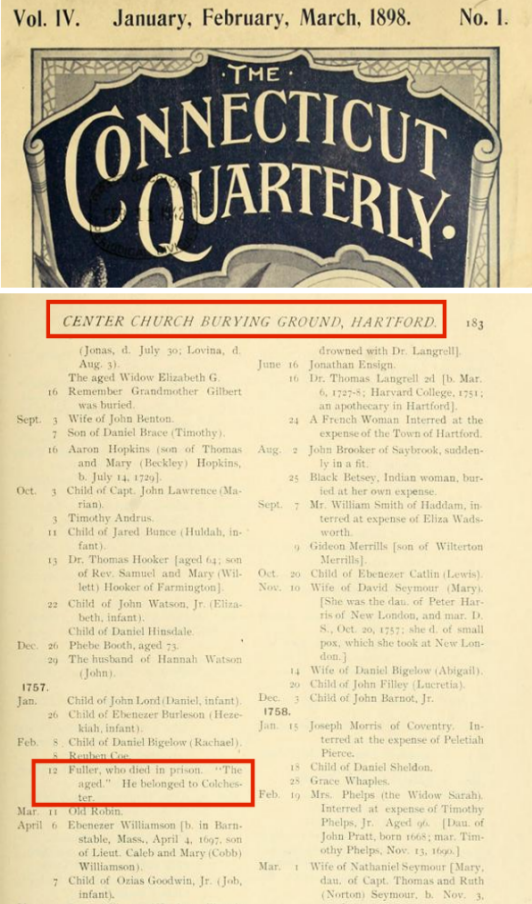 |
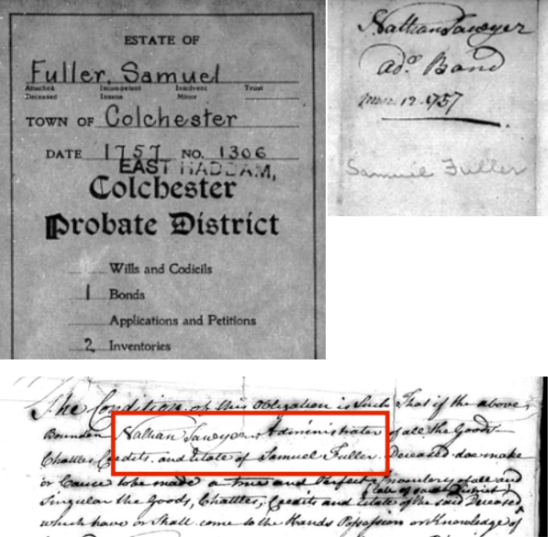 In February 1757, Samuel Fuller of Colchester—father of Abner⁵ Fuller—died while confined in the Hartford County Prison. Contemporary references to the death of an “Aged Fuller of Colchester” correspond precisely with Samuel’s age and circumstances, and no other Samuel Fuller of comparable age appears in the region at that time. Although the surviving records do not detail the conditions of his imprisonment, the timing aligns with the substantial debt case involving Newport merchant John Bannister, in which Samuel and his son Abner were defendants. Colonial debt laws of the era routinely resulted in incarceration when repayment could not be made, and Samuel’s death in custody reflects the harsh legal and economic realities faced by many families in mid-18th-century Connecticut. Following Samuel’s death, the Hartford Probate Court appointed Nathan Sawyer as administrator of his estate. This appointment is genealogically significant because Nathan Sawyer was married to Samuel’s daughter, Desire Fuller, establishing an unmistakable familial link between the deceased and the appointed administrator. The probate record confirms both Samuel’s identity and his relationships within the Fuller family, providing key documentation for reconstructing the family structure during this period. Sawyer’s role also underscores the close involvement of Samuel’s extended family in settling the estate, offering strong supporting evidence that the “Aged Fuller” who died in the Hartford prison in 1757 was indeed Samuel Fuller, father of Abner⁵ Fuller. |
|
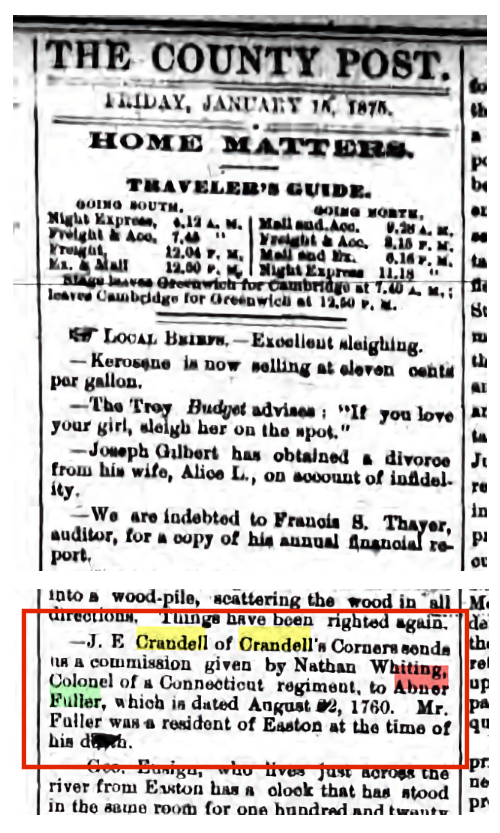
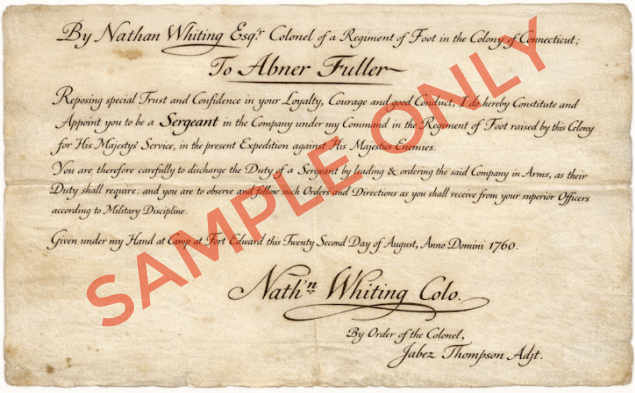
1760 Commission by Col. Nathan Whiting The 1875 news item from the Washington County Post provides a remarkable and independently sourced link between Abner Fuller of Easton, New York, and his earlier military service in Connecticut under Colonel Nathan Whiting. The newspaper reports that J. E. Crandell of Crandell’s Corners preserved a military commission issued to “Abner Fuller” on August 22, 1760, signed by Colonel Nathan Whiting, a well-documented officer who commanded Connecticut provincial troops during the French & Indian War. This aligns directly with surviving muster rolls from 1755–1760 identifying Abner Fuller of Colchester as a soldier serving under Whiting. The commission’s survival in Easton—where Abner later lived, farmed, and died—creates a compelling geographical and historical bridge between his Connecticut origins and his New York residency. This document is especially significant because it demonstrates a continuous identity across both locations and over decades. The presence of Colonel Whiting’s 1760 commission in Easton could only occur if the same Abner Fuller who served in Connecticut later migrated to New York, bringing his military papers with him. This directly refutes older genealogical assumptions that Abner “died young” and instead confirms that he lived into old age as a resident of Easton. The commission therefore stands as an important artifact—corroborating his military service, validating his presence in the Schaghticoke/Easton region, and strengthening the chain of evidence proving that Abner⁵ Fuller of Colchester and Abner Fuller of Easton were one and the same man. The original document will probably never be found. Here is a sample of a period commission.
|
 |
| 1763 Birth of Mary, 1765 birth of Samuel, 1770 birth of Sarah, 1773 birth of Abner Jr, and other children 1776-1786 |
| 1772 Indenture for Farm #5 in Philip Schuyler's will, 1857 newspaper notice |
| 1779 Saratoga Tax List |
| New Hampshire land grant for service in Revolution, Albany County Regiment |
| 1809 Abner will, 1839 Samuel will |
| 1824 death and burial in George Brownell farm cemetery |
| Charlotte Fuller DAR application |
| Lineage from Abner Jr in Montgomery County |
| Footer, contributors, acknowledgments |